Pre-testnet development preview
Public network, benchmarks and independent audit not yet available.
StatusPost-Quantum
Security Profile v1
Cryptographic surfaces Zeqron targets for post-quantum readiness. This is a development profile — not a certification or audit attestation.
Last reviewed: 2026-09-07 · Profile revision: 1.0-draft · Compatibility: pre-testnet
Executive summary
Hot-path signatures use ML-DSA-87 (FIPS 204, NIST category 5). Session key establishment uses ML-KEM-1024 via QronHandshake. Cold-path anchors use SLH-DSA-SHA2-128s (category 1). Hash and STARK assumptions are tracked separately.
Expand registry entries below for design, implementation, validation and audit fields. Deep normative tables (handshake, STARK, Poseidon2) remain collapsible for exploratory reading.
Scope and non-claims
- Algorithm choices follow NIST PQC standards (FIPS 203/204/205) — not NIST or FIPS validated products.
- ML-KEM is for key establishment; ML-DSA / SLH-DSA are for signatures (different roles).
- No public comparative benchmarks or production network claims on this portal.
What post-quantum means here
- PQ signatures for transaction and protocol identities (ML-DSA-87 hot path).
- PQ key establishment for authenticated channels (ML-KEM-1024 / QronHandshake).
- Versioned cryptographic suites for future migration (crypto-agility).
- Hash and proof-system assumptions tracked independently (ParallelHash, BLAKE3, Poseidon2/STARK).
ML-DSA-87 and ML-KEM-1024 use NIST security category 5 parameter sets. Other components (including SLH-DSA-SHA2-128s, AEAD, KDFs, hashes) are tracked separately and do not inherit category 5 automatically.
Cryptographic surfaces (editorial)
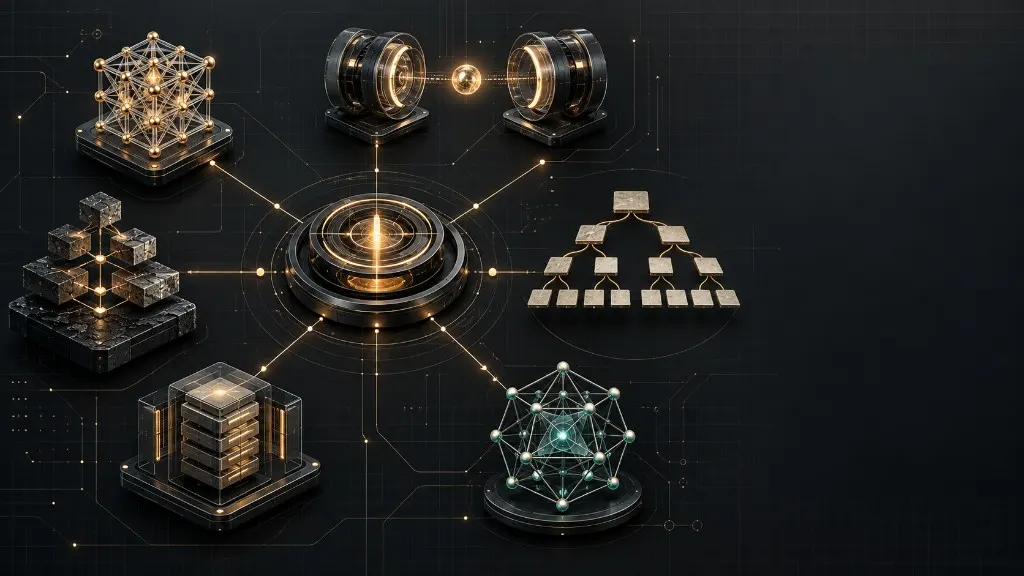
Technical description
Cyber-industrial illustration of Zeqron cryptographic surfaces around a central hub: lattice/hash structure, key-exchange cylinders with an amber shared secret, hierarchical commitment tree, turquoise polyhedron for proving paths, encased storage stack, and stepped DAG/consensus blocks. Right side intentionally open for HTML legend. Graphite, amber and turquoise on a dark grid. Editorial art only — not a normative suite specification.
Cryptographic suite registry
ML-DSA-87 signatures
Internal buildExpand
Hot path — transactions, consensus messages, governance votes (FIPS 204, NIST security category 5 parameter set).
- Design
- Accepted — RFC-CRYPTO-PQ-002 / PQ-004
- Implementation
- Internal build — zeqron-crypto crates
- Validation
- Under validation — KATs and protocol integration in progress
- Availability
- Private — not publicly released
- Audit
- Not audited
ML-KEM-1024 KEM
Internal buildExpand
Key encapsulation for authenticated channels — not a signature algorithm (FIPS 203, NIST security category 5 parameter set).
- Design
- Accepted — RFC-CRYPTO-PQ-004 INV-CRYPTO-002
- Implementation
- Internal build — used by QronHandshake
- Validation
- P2P session establishment under validation
- Availability
- Private — interop not publicly tested
- Audit
- Not audited
QronHandshake (P2P)
Under validationExpand
Protocol-native authenticated session establishment for Zeqron P2P connections, using ML-KEM-1024, ML-DSA-87, ChaCha20-Poly1305 and HKDF-SHA3-256.
- Design
- RFC-NET-003 (draft) + architecture decision approved 2026-05-23. Transport relationship: operates at the Zeqron protocol layer on QUIC; relationship with TLS 1.3 / hybrid transport remains under security validation. Audit planned.
- Implementation
- Internal — qron-p2p-core handshake
- Validation
- Internal tests; external crypto audit planned
- Availability
- Private
- Audit
- Audit planned — not completed
SLH-DSA-SHA2-128s cold path
In developmentExpand
Long-lived anchors, recovery, infrequent governance / epoch seals (FIPS 205; NIST security category 1 parameter set SLH-DSA-SHA2-128s / SLH-DSA-128s).
- Design
- Architecture defined — CH-5 / crypto-pq master
- Implementation
- Integration in progress — not fully wired end-to-end
- Validation
- Pending completion of cold-path policy engine
- Availability
- Private
- Audit
- Not audited
Crypto-agility layer
RFC acceptedExpand
Versioned suite negotiation and migration without implying a hard fork when possible (RFC-CRYPTO-PQ-005).
- Design
- RFC accepted — capability manifests designed
- Implementation
- Partial crate wiring — in development
- Validation
- Not complete
- Availability
- Private
- Audit
- Not audited
Hashing and commitments
Internal buildExpand
Protocol hashing: ParallelHash (SP 800-185) with domain separation; BLAKE3 for DID/QronId surfaces; Poseidon2 inside STARK/VRF paths; KMAC256 for authenticated storage.
- Design
- RFC-CRYPTO-PQ-004 + storage RFCs
- Implementation
- Internal crates (zeqron-types, storage, crypto)
- Validation
- Canonical vectors in repo — publication pending
- Availability
- Private
- Audit
- Not audited
Accounts and addresses
DesignedExpand
Multiple coexisting identifiers from ML-DSA-87 pubkeys — not a single frozen public address standard yet.
- Design
- 32-byte Address (ParallelHash); DID BLAKE3+multibase (RFC-DID-001 Accepted); QronId display qron1… (RFC-NET-002 Draft)
- Implementation
- Internal — hash choice still drifts across surfaces (BLAKE3 vs ParallelHash)
- Validation
- Interop not frozen
- Availability
- Pre-testnet
- Audit
- Not audited
Consensus message signatures
Internal buildExpand
Architecture D uncertified DAG — vertices commit via DAG support, not hot-path QCs. Quorum measured in effective power under QronMerit.
- Design
- RFC-CONSENSUS-001 + RFC-QRONMERIT-001 (Approved)
- Implementation
- zeqron-consensus — CRQ enabled by default in params
- Validation
- Internal Byzantine / quorum tests
- Availability
- Private / pre-testnet
- Audit
- Not audited
QronMerit (consensus weighting)
Internal buildExpand
Effective voting power = stake × reputation; quorum ≈ 2/3 effective power; 20% reputation floor; epoch-based decay and recovery. Same inputs → same effective power (protocol-defined); reputation updates per epoch.
- Design
- RFC-QRONMERIT-001 Approved
- Implementation
- zeqron-consensus — CRQ enabled by default
- Validation
- Internal adversarial / Byzantine tests
- Availability
- Private / pre-testnet
- Audit
- Not audited
Zero-knowledge (Hologram / STARK)
Internal buildExpand
Transparent STARK proofs (Plonky3 / Poseidon2) — not pairing-based SNARKs. PQ assumptions tracked separately from classical curves.
- Design
- RFC-STARK-001 — Poseidon2BabyBear (width=32) + FRI targets; BabyBear field — under internal validation
- Implementation
- Plonky3 toolkit wired in proof crates + SDK hologram — parameter sets per circuit, not a single frozen public profile
- Validation
- Internal POC benchmarks — not public comparative results
- Availability
- Private
- Audit
- Not audited
Key lifecycle
In developmentExpand
Rotation, recovery, and cold-path dual-sig patterns. Hardware / HSM paths remain roadmap items.
- Design
- RFC-IDENTITY-002 + custody RFCs
- Implementation
- Partial — wallet private preview
- Validation
- Incomplete
- Availability
- Private preview
- Audit
- Not audited
Hashing policy matrix
| Surface | Primitive | Reason | Status | Substitution |
|---|---|---|---|---|
| Protocol IDs | ParallelHash | Domain separation | Internal | Versioned |
| DID/QronId | BLAKE3 | Performance/tooling | Under review | Not frozen |
| ZK/STARK | Poseidon2 | Native to Plonky3/BabyBear STARK paths | Under validation · decision retained (scoped) | Crypto-agile · reassess vs BLAKE/SHA proving stacks |
| Storage MAC | KMAC256 | Authenticated storage | Internal | Versioned |
| KDF | HKDF-SHA3-256 | Session derivation | Internal | Suite-bound |
Poseidon2 is currently evaluated only within specific internal proof-system paths. Its use is parameter-set dependent, not treated as a universal protocol hash, and remains replaceable through the cryptographic suite registry.
QronHandshake normative profile (design targets)
Expand
A three-message mutual-authentication flow inspired by the identity-hiding properties of Noise XX, adapted to ML-KEM and ML-DSA. It is not wire-compatible with the Noise Protocol Framework. Public portal claim: protocol-layer session crypto on QUIC — relationship to TLS 1.3 remains under security validation; external audit planned. Do not treat this table as audited KATs.
- Pattern
- Three-message mutual auth (Noise-XX-inspired, KEM-adapted) — ML-DSA-87 over transcript
- KEM
- Ephemeral ML-KEM-1024 key material — forward-secrecy objective under protocol analysis; not yet independently validated.
- Signatures
- ML-DSA-87 static keys; QronId = BLAKE3(pk)[:32]
- AEAD
- ChaCha20-Poly1305 (nonce 96-bit, tag 128-bit)
- KDF
- HKDF-SHA3-256 — salt from transcript; labels e.g. qron-hs-1 / qron-session
- Transcript
- BLAKE3 over handshake messages (design)
- Transport
- Zeqron protocol layer on QUIC — TLS hybrid posture under validation
- Downgrade / replay
- Version + mode selection + transcript binding (RFC) — audit pending
- Resumption
- Policy tracked in RFC — not claimed production-ready here
- Status
- Under validation · not audited · KATs not public
| Later compromise | Exposes prior sessions? |
|---|---|
| ML-DSA identity key | Must not (design objective) — authentication only; pending formal analysis |
| ML-KEM static key (if any) | Must be defined — current design targets ephemeral KEM; static KEM not claimed |
| Ephemeral decapsulation key | Affects that session — destroy after handshake (design) |
| Session resumption secret | Must be indicated when resumption ships — policy not production-ready |
| Full node state | Must be defined for operator threat models — not specified on this portal |
STARK profile targets (RFC-STARK-001)
Expand
Transparent STARKs via Plonky3 — not pairing-based SNARKs. Figures below are RFC design targets under internal validation, not a published certified security score for the live network.
- Field
- BabyBear p = 2^31 − 2^27 + 1
- Extension
- Degree 5 binomial extension (challenge / FRI)
- Permutation
- Poseidon2BabyBear width=32, d=7; RF=8, RP=30 (seeded config)
- Sponge
- PaddingFreeSponge Poseidon2 32→16 (capacity design target)
- FRI rate
- log_blowup = 1 (rate 1/2)
- FRI queries
- 128 queries · 24-bit query PoW (RFC uplift targets)
- PCS / DFT
- TwoAdicFriPcs · Radix2DitParallel
- PQ note
- Hash-based assumptions; Grover/FRI accounting in RFC — portal does not assert a frozen public bit-security number
- Migration
- Crypto-agility exit ramp if hash-friendly STARK stacks mature for production circuits
Poseidon2 scope and migration policy
Expand
Public Ethereum Foundation research (2026) is pivoting away from Poseidon for Ethereum L1 toward mature hashes such as SHA / BLAKE, enabled by newer binary-field proving designs (“hash-friendly SNARKs”). That is an important industry signal — it is not identical to Zeqron’s proving stack. Zeqron reviewed its own scoped retention decision in light of that research; Ethereum did not validate Zeqron’s choice.
- Scope: Zeqron already uses BLAKE3 and ParallelHash outside ZK. Poseidon2 is confined to specific Plonky3/BabyBear proving paths, where it is used according to circuit- and proof-profile-specific configurations — not as consensus message hashing or a general address hash.
- Why retain for now: Zeqron’s current internal STARK stack uses Plonky3 with Poseidon2BabyBear (width=32) per RFC-STARK-001. Replacing it requires a proving-path migration, not a one-line hash swap.
- Risk accepted: Poseidon-family hashes are younger and less cryptanalyzed than SHA/BLAKE. We do not claim L1-Ethereum-scale maturity for Poseidon2.
- Exit ramp: Crypto-agility (RFC-CRYPTO-PQ-005) tracks substitution. Reassess when a production-ready hash-friendly STARK path for BLAKE3/SHA exists for our circuits, or when migrating proving toolkits. Protocol hashes remain ParallelHash/BLAKE3 regardless.
Decision status: Retain Poseidon2 for scoped STARK paths · monitor EF/binary-field progress · no universal Poseidon mandate · not audited as a standalone L1 hash.
Honesty notice
Status badges use a shared portal taxonomy (Concept → Production). Prefer the five-field maturity grid over a single “Implemented” label. Full RFCs remain in the development repository.