Pre-testnet development preview
Public network, benchmarks and independent audit not yet available.
StatusArchitecture explorer for the Zeqron protocol. Toggle between a plain-language overview of BlockDAG propose-order-finalize flow and a technical view covering Mysticeti PQ adaptation, QronMerit, QronMesh zones, and ML-DSA signed messages. ZAXON is an agent protocol, not consensus.
How Zeqron works
Two views of the same system — pick the depth that matches your role. Dotted terms open a plain + technical explanation. Maturity lives on status.
Last reviewed: 2026-09-07
Concurrent BlockDAG
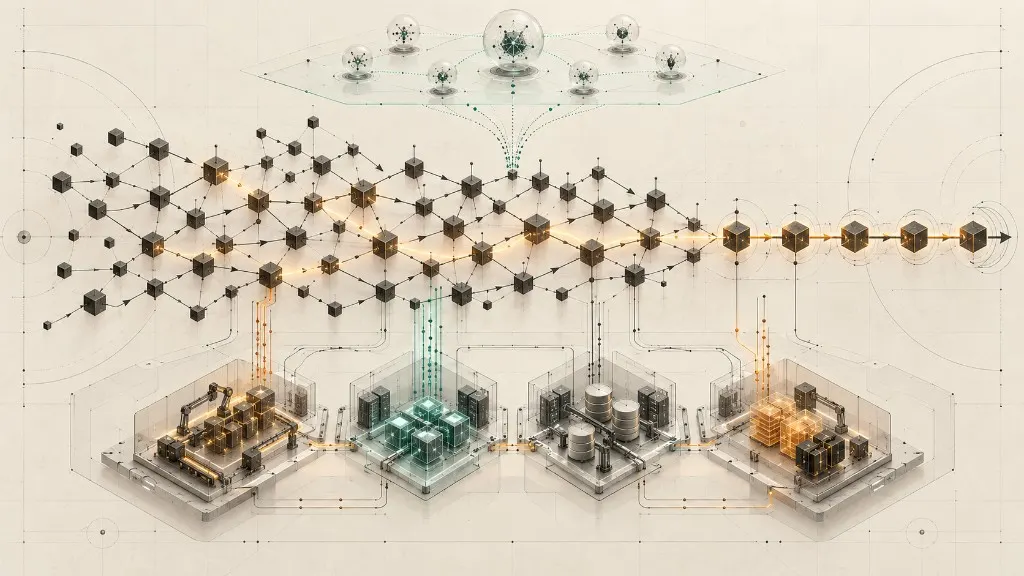
Validators propose in parallel on an uncertified DAG — hot-path vertices are not individually QC'd.
Finality path
Amber path: support and commit rules derive one committed order for honest validators.
Execution zones
Lower modules: QronMesh zones / Move execution linked to consensus state — not the DAG itself.
Semantic layer
Upper plane: QronGraph (KNG) — typed meaning over protocol state, separate from BlockDAG ordering.
Editorial art
Illustration only — not a normative specification. See RFCs for exact rules.
Technical description
Technical illustration of Zeqron's general architecture. A concurrent BlockDAG of graphite cubes spans the center; an amber-highlighted path shows convergence toward a deterministic final order ending in a linear finalized chain on the right. Four glass-encased execution modules sit below, linked vertically to the DAG. A translucent semantic plane with networked spheres floats above. Ivory blueprint background with grid and measurement marks. Editorial art only — not a normative specification.
Protocol field (monochrome)
- 1
Propose in parallel
Validators propose blocks concurrently on a BlockDAG — many candidates can exist at once instead of a single serial chain tip. - 2
Derive a committed order
The protocol derives a deterministic committed order from the locally constructedusing Mysticeti-style support and commit rules, without requiring individual quorum certificates for hot-path vertices. Honest validators converge on the same finalized sequence — stronger than a local causal view alone.uncertified DAG — explain this term
PlainValidators build a DAG of proposals without requiring a separate certificate for every hot-path block before it can participate in commit decisions.
TechnicalArchitecture D / Mysticeti-style: hot-path vertices are not individually QC’d; ordering comes from support and commit rules over the locally constructed DAG.
Architecture - 3
Finalize with BFT
A Byzantine-fault-tolerant finality layer commits ordered blocks once the required validator quorum is reached — measured inunder QronMerit (stake × reputation), not raw validator count alone. Execution scales viaeffective voting power — explain this term
PlainHow much a validator counts toward quorum after multiplying stake by reputation.
Technicaleffective_power = stake × (reputation_ppm / 1_000_000); quorum ≈ 2/3 of total effective power (RFC-QRONMERIT-001).
QronMerit summaryQronMesh — explain this term
PlainHow execution is split into zones so the network can scale without one giant shared machine.
TechnicalQronMesh partitions execution/state into zones with cross-zone integrity rules; it is not the BlockDAG consensus layer.
Architecture.zones — explain this term
PlainSeparate execution domains that process work in parallel and reconnect through protocol rules.
TechnicalSovereign execution zones under QronMesh — throughput scaling path with cross-zone integrity constraints defined in RFCs.
Architecture